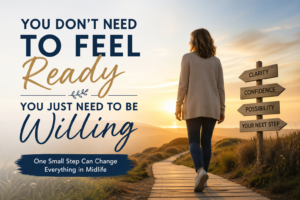

What If You’re Closer Than You Think?
You may be making more progress toward your next chapter than you realize. Here’s how to recognize it, and why you shouldn’t give up just because the results aren’t visible yet.
Quick Takeaways
- ✔️ Progress doesn’t always look like visible results.
- ✔️ Your internal changes can be just as important as external accomplishments.
- ✔️ Don’t measure your timeline against someone else’s.
- ✔️ Small wins are evidence that you’re moving forward.
- ✔️ Your past experience means you’re not starting from zero.
- ✔️ Sometimes progress means stopping the things that are taking you in the wrong direction.
- ✔️ You don’t need to see the entire path to take the next step.
What If You’re Further Along Than You Think?
Have you ever looked at your life and thought:
“I’m not getting anywhere.”
Maybe you’ve been thinking about changing careers.
Maybe you’re trying to figure out what kind of work you actually want to do next.
Maybe you’ve started exploring a business idea.
Maybe you’re trying to rebuild your confidence after a difficult chapter.
Or maybe you simply want your life to feel more aligned with who you’ve become.
You’ve been thinking.
Researching.
Learning.
Having conversations.
Trying things.
Taking small steps.
And yet…
when you look at the results, you don’t see much.
You’re still uncertain.
You’re still figuring things out.
You haven’t reached the destination you imagined.
And that can make you wonder:
“Am I actually making progress?”
I think this is one of the hardest parts of reinvention.
We tend to recognize progress when it produces something obvious.
A new job.
A promotion.
A successful business.
More money.
A completed goal.
A dramatic change.
But many of the most important forms of progress don’t look like that at first.
Sometimes progress looks like asking a question you were afraid to ask.
Sometimes it looks like admitting that something isn’t working anymore.
Sometimes it’s learning a new skill.
Sometimes it’s finally having a difficult conversation.
Sometimes it’s realizing what you don’t want.
And sometimes…
it’s simply deciding that you’re not willing to spend the next decade living the way you’ve been living.
Those things may not look like much from the outside.
But they can represent enormous movement on the inside.
Progress Doesn’t Always Look Like Results
Imagine someone who decides they want to change careers.
Their first step might be updating their résumé.
Then researching industries.
Then talking to someone who works in a field they’re considering.
Then taking a course.
Then applying for a few positions.
Maybe nothing happens immediately.
No job offer.
No dramatic breakthrough.
No announcement on LinkedIn.
From the outside, it might look like nothing has changed.
But that’s not necessarily true.
They’ve learned.
They’ve explored.
They’ve gathered information.
They’ve clarified what they want.
They’ve tested assumptions.
They’re building confidence.
They’re moving.
The same thing happens when someone starts building something of their own.
Before there is income, there is usually learning.
Before there is an audience, there is usually creating.
Before there is confidence, there is usually uncertainty.
Before there is clarity, there are usually questions.
And before there is a finished next chapter…
there is usually a period where it feels like nothing is happening.
That’s why it’s important not to confuse a lack of visible results with a lack of progress.
They aren’t the same thing.
Look in the Rear-View Mirror
There’s another reason progress can be difficult to recognize.
When you’re focused on where you’re going, you’re constantly looking at the distance ahead.
You see everything you haven’t accomplished.
Everything you still need to learn.
Every unanswered question.
Every obstacle.
Every gap between where you are and where you want to be.
But occasionally, you need to look backward.
Think about where you were two years ago.
Or even six months ago.
What did you believe then?
What were you worried about?
What did you think was impossible?
What were you tolerating?
What hadn’t you considered yet?
And then ask:
What’s different now?
Maybe you have more clarity.
Maybe you’ve become more willing to take a risk.
Maybe you’re finally exploring possibilities you once dismissed.
Maybe you’ve realized that your definition of success has changed.
Maybe you’re no longer willing to sacrifice your health, time, relationships, or peace of mind for a job title.
Maybe you’ve discovered strengths you didn’t realize you had.
That is progress.
It may not appear on a résumé.
It may not show up in your bank account yet.
But it matters.
Sometimes the first sign of reinvention isn’t that your circumstances have completely changed.
It’s that you’ve changed the way you’re looking at your circumstances.
Don’t Discount the Invisible Work
Some of the most important work you’ll do during a transition is invisible.
Nobody sees the hours you spend thinking.
Nobody sees the research you do late at night.
Nobody knows about the conversations you’re having with yourself.
Nobody sees you questioning old assumptions.
Nobody sees you trying something, realizing it isn’t right, and adjusting.
Nobody sees the courage it takes to start again.
And because nobody sees it…
you may be tempted to dismiss it.
Don’t.
The thinking matters.
The learning matters.
The experimenting matters.
The mistakes matter.
Even changing your mind can be progress.
You aren’t necessarily going backward because you tried something and discovered it wasn’t right for you.
You may actually be getting closer to what is right.
That’s particularly important in midlife.
You don’t have to get every decision right on the first attempt.
You have something you didn’t have when you were younger:
experience.
You’ve learned from the things that worked.
You’ve learned from the things that didn’t.
And you’ve learned more about yourself along the way.
That information is valuable.
Your Past Self May Not Recognize You
Here’s a simple exercise I encourage you to try.
Think back to yourself five years ago.
Or two years ago.
Ask yourself:
What did I believe about my future?
What was I afraid of?
What did I think I had to tolerate?
What did I think was no longer possible for me?
Now look at yourself today.
You may discover that you’ve changed more than you realized.
Perhaps you have a different definition of success.
Perhaps you care less about impressing people and more about creating a life you actually enjoy.
Perhaps you’re more comfortable saying no.
Perhaps you’re more willing to question the path you’ve been on.
Perhaps you’re beginning to understand what you want from the next chapter.
You might even realize that the person you were five years ago couldn’t have imagined some of the things you know today.
That’s worth acknowledging.
Because reinvention isn’t always about becoming someone completely different.
Sometimes it’s about becoming more fully yourself.
Stop Comparing Your Timeline to Someone Else’s
One of the quickest ways to make your own progress feel insignificant is to compare it to someone else’s.
You see someone who changed careers at 45.
Someone who started a business at 50.
Someone who seems to have figured everything out.
Someone who built something impressive in twelve months.
And you wonder:
“Why am I not there yet?”
But you don’t know their entire story.
You don’t know what resources they had.
You don’t know who supported them.
You don’t know what responsibilities they were carrying.
You don’t know how many years of struggle happened before you ever heard about their success.
And you certainly don’t know what their life looks like when the camera is turned off.
Their timeline isn’t your timeline.
Midlife reinvention isn’t a race.
There is no prize for getting to your next chapter first.
The question isn’t:
“Am I moving as fast as they are?”
The question is:
“Am I moving toward a life that fits me?”
That’s a much more useful measure of progress.
Small Wins Are Still Wins
We often overlook small wins because they don’t feel important enough.
But small wins are evidence.
You finally make the phone call you’ve been putting off.
You update your résumé.
You publish your first video.
You take a course.
You have the conversation.
You set the boundary.
You research the possibility.
You apply for the position.
You say no to something that isn’t right.
You say yes to something that scares you.
Each one is a piece of evidence.
And those pieces accumulate.
One decision.
One conversation.
One experiment.
One skill.
One application.
One boundary.
One step.
One brick.
Eventually, those individual pieces begin to form something larger.
That’s why I’ve come to believe that you don’t need to build the entire next chapter today.
You just need to lay the next brick.
Then another.
Then another.
And eventually, you’ll look back and realize you’ve built something you couldn’t see when you started.
You Don’t Need to Feel Confident to Make Progress
There’s another trap worth avoiding.
We sometimes think we need confidence before we take action.
But confidence often works in the opposite direction.
You take the step…
and then confidence follows.
You have the conversation and discover you can handle it.
You apply for the position and realize your experience is more valuable than you thought.
You try something new and discover you’re capable of learning it.
You create something and realize you actually enjoy the process.
You make a difficult decision and discover that you can live with the uncertainty.
Each experience gives you evidence.
And evidence creates confidence.
So if you’re waiting to feel completely confident before moving forward…
you may be waiting a very long time.
You don’t need certainty.
You need enough willingness to take the next step.
You’re Not Starting From Zero
This may be one of the most important things to remember in midlife.
You’re not starting from zero.
You may be starting something new.
But you aren’t starting from nothing.
You’re bringing decades of experience with you.
You’ve developed skills.
You’ve solved problems.
You’ve worked with people.
You’ve navigated difficult situations.
You’ve made mistakes.
You’ve recovered from disappointments.
You’ve learned things the hard way.
You’ve developed perspective.
All of that comes with you.
Your previous career doesn’t have to dictate your future.
But it can contribute to it.
The challenge isn’t to throw everything away and become somebody else.
The challenge is to ask:
“What from my experience belongs in my next chapter?”
Maybe it’s your communication skills.
Your leadership.
Your ability to solve problems.
Your understanding of people.
Your industry knowledge.
Your resilience.
Your ability to recognize patterns.
Your hard-earned wisdom.
Your experience may be more transferable than you realize.
Sometimes Progress Means Changing Direction
There’s another kind of progress we don’t talk about enough.
Sometimes progress means stopping.
Stopping something that isn’t working.
Leaving a situation that is draining you.
Admitting that a goal isn’t really yours anymore.
Walking away from an opportunity that isn’t aligned.
Changing your mind.
Setting a boundary.
Letting go of an identity you’ve outgrown.
From the outside, that may not look like progress.
But it can be one of the most important steps you take.
Because sometimes you have to stop walking in the wrong direction…
before you can start moving in the right one.
That’s not failure.
That’s discernment.
And sometimes the fastest way toward your next chapter is to stop investing your energy in the chapter you’re trying to leave.
Reflection Exercise: What If You’re Closer Than You Think?
Take 10-15 minutes this week and answer these questions honestly.
1. What do I know now that I didn’t know a year ago?
Think about skills, priorities, values, relationships, opportunities, and yourself.
2. What am I doing now that I wasn’t doing before?
Look for action, even small action.
3. What am I no longer willing to tolerate?
Sometimes knowing what you don’t want is an important form of clarity.
4. What have I become more willing to explore?
This could be a career direction, business idea, lifestyle change, or simply a different way of approaching your life.
5. What small wins have I overlooked?
Don’t dismiss them because they seem insignificant.
6. What if I’m actually further along than I think?
Sit with that question for a moment.
You don’t have to convince yourself that everything is going perfectly.
You simply have to consider the possibility that your progress is real, even if the final result isn’t visible yet.
Final Thoughts
If you’re in the middle of reinvention right now, there will probably be days when you wonder whether any of this is working.
That’s normal.
There will be days when the distance ahead seems enormous.
There will be days when someone else’s success makes your own progress feel small.
And there will be days when you wonder whether you’re wasting your time.
When those days come, look backward.
Remember what you know now.
Remember what you’ve survived.
Remember what you’ve learned.
Remember the things you’re no longer willing to accept.
Remember the steps you’ve already taken.
And remember:
Being unfinished doesn’t mean you’re stuck.
You can be uncertain and still be moving forward.
You can be figuring things out and still be making progress.
You can be building something nobody else can see yet.
And you may be much closer than you think.
So don’t demand that every step produce immediate proof.
Keep learning.
Keep paying attention.
Keep making adjustments.
Keep the promises you make to yourself.
And when you don’t know what the entire path looks like…
lay the next brick.
Because progress isn’t always obvious while you’re living it.
Sometimes you only recognize how far you’ve come…
when you finally stop and look back.
Continue Your Reinvention
If you’re ready to create a little more clarity around where you are and what deserves your attention next, there are a few ways I can help.
Start with The 15-Minute Reset.
It’s a simple way to step back from the noise, reconnect with what matters, and identify what deserves your attention right now.
Go deeper with The Midlife Clarity Reset Workbook.
If you’re ready to spend more time working through the questions behind your next chapter, the workbook gives you a structured place to do that.
Or work with me personally through a Midlife Clarity Session.
Sometimes you don’t need someone to tell you what to do. You need a place to slow down, think clearly, and work through the possibilities with someone who understands midlife career transition.
Your next chapter doesn’t have to be figured out all at once.
Build a life that fits you.
One intentional step at a time.
Talk soon,
Denny
P.S. Please let me know how this post has helped you, any feedback or experience you feel comfortable sharing. I look forward to reading your thoughts, experiences, and help as much as I can!!
————————–
(Any guides, Workbooks, quizzes and one-to-one clarity sessions are my own and not affiliate based. Please note, I do sometimes share other affiliate links of trusted products and when purchased through a hyperlink on my website may potentially result in a small commission for me. These commissions are not an additional cost to you. I only share products and services I use and trust.)