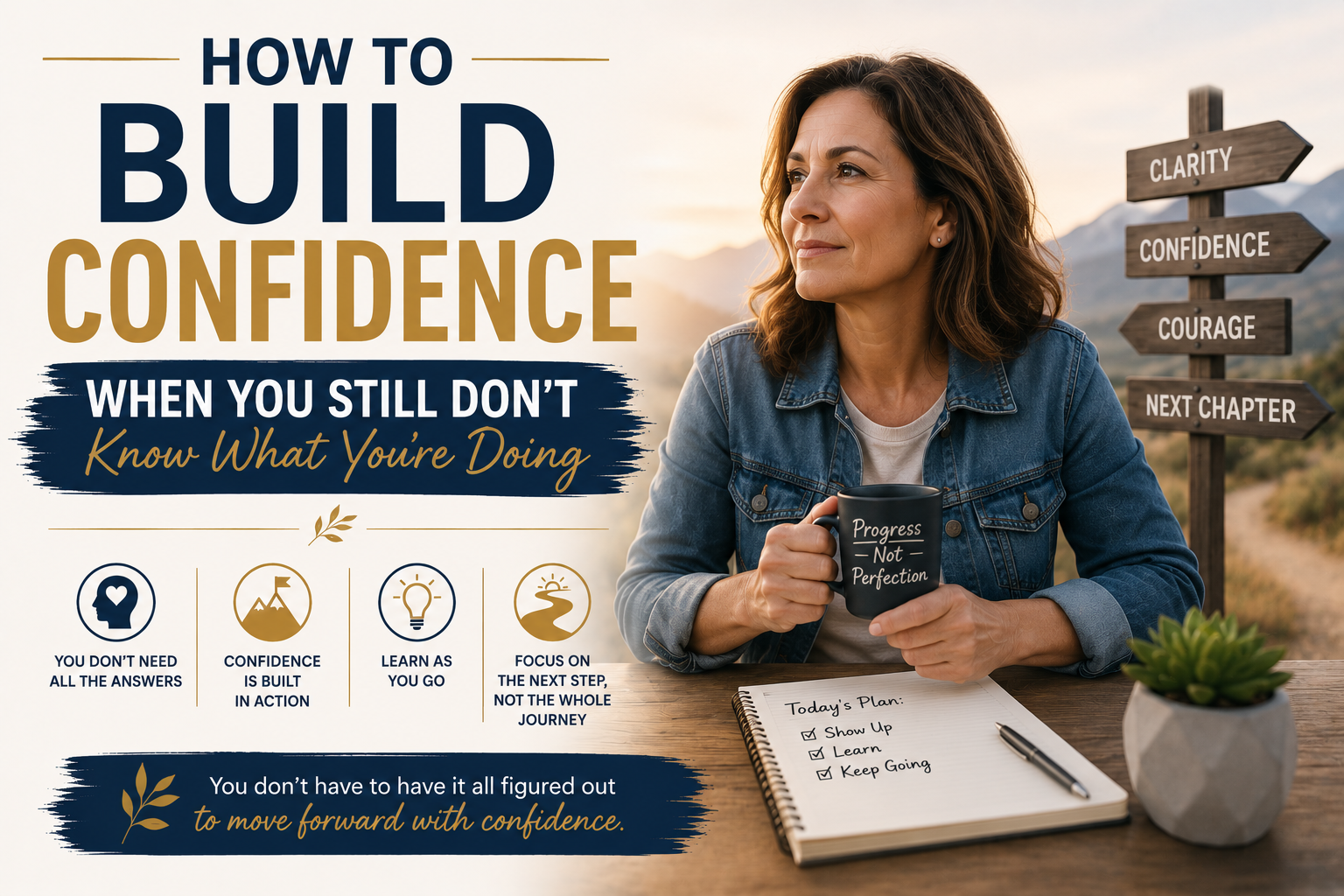
How to Build Confidence When You Still Don’t Know What You’re Doing
You don’t need to feel completely ready before building your next chapter. Confidence often grows from taking small, thoughtful actions and collecting evidence along the way.
There are four words that have probably delayed more career changes, new businesses, creative ideas, and personal reinventions than most of us realize:
“I’m just not ready.”
Maybe you’ve said them recently.
You have an idea you’re considering.
A different career has caught your attention.
You’ve thought about creating another source of income.
Maybe you’ve considered coaching, consulting, freelancing, affiliate marketing, creating content, or building something of your own.
Part of you wants to explore it.
But another part keeps saying:
I need to feel more confident first.
So you research.
You plan.
You watch videos.
You read articles.
You save posts.
You make lists.
And you wait for the day when you finally feel ready.
But what if confidence doesn’t work that way?
What if confidence isn’t something you find before you begin?
What if it’s something you build because you began?
That small shift in thinking can completely change how you approach your next chapter.
Quick Takeaways
In this article, you’ll learn:
- ✔️ Why waiting to feel confident often keeps midlife professionals stuck
- ✔️ How action creates evidence and evidence builds confidence
- ✔️ Why experience can make us more cautious in midlife
- ✔️ How to stop turning disappointing outcomes into conclusions about yourself
- ✔️ Why small experiments are often more useful than big commitments
- ✔️ A simple exercise to help you collect useful evidence this week
The Confidence Myth
Think about the first day of almost any job you’ve ever had.
You probably didn’t walk through the door knowing everything.
You had questions.
You made mistakes.
You forgot names.
You learned systems.
You figured out how things worked.
Eventually, something changed.
The tasks that once felt uncomfortable became familiar.
The questions you once asked became questions other people started asking you.
You became more confident.
But confidence didn’t appear before you started the job.
It developed because you did the work.
You took action.
That action gave you experience.
The experience gave you evidence.
And the evidence slowly built confidence.
Yet when we consider changing direction in midlife, we often expect ourselves to follow a completely different process.
We tell ourselves:
I’ll apply when I feel more confident.
I’ll start the business when I feel ready.
I’ll offer the service when I know more.
I’ll create the content when I’m comfortable on camera.
We imagine confidence comes first.
Then action.
But in most meaningful areas of life, the process works in the opposite direction.
Action creates evidence. Evidence builds confidence.
Confidence Isn’t the Price of Admission
I’ve experienced this myself with creating videos.
Speaking with people has never been the biggest challenge for me.
I’ve spent years in career development. I’ve worked one-on-one with people and spoken to groups.
Put me in a conversation with someone and give me a topic I understand, and I can usually talk about it.
Put me alone in a room with a camera?
That’s different.
There’s no facial expression telling you someone understands.
No question to respond to.
No natural back-and-forth.
For a long time, heavily scripting my videos helped.
It gave me structure.
It reduced the fear of forgetting what I wanted to say.
And, honestly, it helped me start.
Now I’m experimenting with a more conversational approach.
Am I completely comfortable with it yet?
No.
But if I waited until I felt completely confident before recording videos, there probably wouldn’t be a YouTube channel.
I had to record.
Learn.
Adjust.
Record again.
Every video became another piece of evidence.
Not evidence that I was perfect.
Evidence that I could keep improving.
That’s an important distinction.
Confidence isn’t the price of admission. It’s the evidence you collect along the way.
Why Midlife Can Make Us More Cautious
There’s another reason confidence becomes complicated in midlife.
We know more.
That’s usually an advantage.
Experience gives us judgment.
Perspective.
Wisdom.
But experience also teaches us what can go wrong.
By midlife, you may have experienced a difficult employer.
A job loss.
Financial stress.
A business idea that didn’t work.
A relationship that changed.
A health challenge.
An unexpected family responsibility.
You’ve learned that good intentions don’t guarantee good outcomes.
At 25, sometimes we move because we don’t understand everything that could go wrong.
At 50, sometimes we don’t move because we understand exactly what could go wrong.
Wisdom protects us.
But if we’re not careful, it can also paralyze us.
The goal isn’t to become reckless.
You don’t need to ignore your responsibilities or gamble your future on an impulsive decision.
The goal is to stop treating uncertainty as proof that you shouldn’t move.
You can make a thoughtful decision.
You can use the Decision Compass™ to check whether you’re choosing from fear, comparison, or purpose.
You can use the Midlife Income Fit Filter™ to evaluate whether an opportunity fits your experience, personality, lifestyle, season of life, and long-term vision.
And you can still feel uncertain.
Uncertainty doesn’t automatically mean you’ve chosen the wrong direction.
Sometimes it simply means you’re doing something new.
Confidence Needs Evidence
Think about something you’re confident doing today.
Driving.
Using technology.
Managing difficult conversations.
Leading meetings.
Solving problems at work.
Supporting your family.
Whatever came to mind, there’s a good chance you weren’t always confident doing it.
You became confident through repetition and experience.
You collected evidence.
Evidence that you could learn.
Evidence that you could adjust.
Evidence that you could solve problems.
Evidence that you could recover when something didn’t go as planned.
I think confidence works like a loop:
Action → Evidence → Confidence → Bigger Action
You take a small action.
That action gives you information.
The information gives you evidence.
The evidence creates a little more confidence.
That confidence allows you to take a slightly bigger action.
And the loop continues.
The problem is that many people want to skip directly to confidence.
They want to feel capable before doing the thing that would help them become capable.
Unfortunately, you can’t collect evidence while standing still.
Start Smaller Than You Think
One reason people remain stuck is because the action they’re imagining is too large.
Thinking about coaching?
Suddenly you’re imagining launching a complete coaching business, building a website, creating packages, setting prices, and finding twenty clients.
Thinking about freelancing?
Now you’re imagining replacing your full-time income.
Thinking about creating content?
You’re worrying about reaching ten thousand subscribers before you’ve recorded your first video.
Thinking about changing careers?
You’re imagining resigning tomorrow.
No wonder you don’t feel confident.
You’ve turned exploration into a life-altering commitment.
Instead, make the action smaller.
Interested in coaching?
Have one practice conversation.
Interested in consulting?
Speak with someone who experiences the problem you think you could help solve.
Interested in freelancing?
Complete one small project.
Interested in content creation?
Publish one piece of content.
Interested in another career?
Have one informational conversation with someone already doing the work.
The purpose of the first action isn’t to prove your entire future will work.
It’s to learn something useful.
Small actions create evidence. Evidence creates confidence.
But What If the Evidence Is Negative?
This is where the process becomes uncomfortable.
You take action.
And it doesn’t work.
You publish the video and twelve people watch it.
You offer a service and nobody buys.
You apply for a position and don’t receive an interview.
You try something new and discover you’re not very good at it.
At least not yet.
What happens to your confidence then?
For many people, one disappointing outcome quickly becomes an identity.
The video didn’t perform. I’m bad at YouTube.
The offer didn’t sell. Nobody wants what I can provide.
I didn’t get the interview. I’m too old to compete.
We take a result and turn it into a conclusion about ourselves.
But a result is information.
A result is data. It isn’t a definition of who you are.
One unsuccessful job application could mean your résumé wasn’t targeted effectively.
The applicant pool may have been unusually strong.
The employer may have had an internal candidate.
Your experience may not have been communicated clearly.
Or the position simply wasn’t the right fit.
The result matters.
But the story you attach to the result matters too.
Failure Is Still Evidence
When I say confidence needs evidence, I’m not suggesting every action needs to succeed.
Sometimes the evidence is simply:
I tried.
I survived.
I learned.
I adjusted.
I tried again.
That’s evidence.
Sometimes confidence isn’t built by proving you can succeed.
Sometimes confidence is built by proving you can recover.
And if you’re in midlife, you probably have more evidence of that than you realize.
Think about the changes you’ve already navigated.
Jobs you had to learn.
Technology you adapted to.
Workplace changes you didn’t request.
Difficult conversations you survived.
Financial challenges you worked through.
Family responsibilities you never expected.
You may not have chosen every change that entered your life.
But you’re still here.
You adapted.
You learned.
You figured things out.
That’s evidence.
Sometimes you don’t need more confidence.
You need to look at the evidence you’ve already collected.
Stop Asking, “Am I Ready?”
Maybe “Am I ready?” isn’t the most useful question.
If you’re doing something genuinely new, the answer may be:
Not completely.
That’s normal.
A better question might be:
“What’s the smallest action I can take that will give me useful evidence?”
That question removes the pressure to prove your entire future.
It gives you permission to experiment.
To learn.
To adjust.
And experimentation is one of the safest ways to approach reinvention.
You don’t need to make a five-year commitment to explore an idea.
You need enough curiosity to take one thoughtful step.
How the July Lessons Connect
If you’ve been following this month’s content, you may notice how the ideas are beginning to build on each other.
First, we explored the Midlife Income Fit Filter™.
The question was:
Does this opportunity fit me?
Then we introduced the Decision Compass™.
The question became:
Why am I choosing it?
Now we’re asking:
What’s one action I can take to collect real evidence?
Fit.
Intention.
Evidence.
Those three ideas create a very different approach to midlife reinvention.
You’re not blindly chasing opportunities.
You’re not waiting for perfect certainty.
You’re evaluating thoughtfully and moving intentionally.
Reflection Questions
Take a few minutes with these questions.
Write your answers if you can.
- What have I been waiting to feel more confident about?
- What am I afraid might happen if I take action?
- Have I turned a disappointing result into a negative conclusion about myself?
- What difficult situations have I already adapted to in my life?
- What evidence do I already have that I can learn, adjust, and recover?
- What’s one small action that could give me useful information about my next step?
You may discover that you already have more evidence than you thought.
This Week’s Reinvention Exercise
Choose one direction you’ve been considering.
Just one.
Now complete this sentence:
“The smallest action I could take in the next seven days to collect useful evidence is…”
Keep the action small.
You aren’t trying to prove the idea will work forever.
You’re trying to learn something.
Maybe you’ll speak to someone.
Create something.
Offer something.
Research a specific question.
Apply for one opportunity.
Publish one piece of content.
Then, after you take the action, ask:
What did I learn?
What evidence did I collect?
What would I adjust next time?
That’s how confidence grows.
Not through endless preparation.
Through thoughtful action and honest reflection.
Final Thoughts
You may be waiting to feel like the person who’s capable of building your next chapter.
But what if becoming that person is the result of building it?
What if confidence isn’t something you’re supposed to find before you begin?
What if it’s something you create one piece of evidence at a time?
You don’t need to feel completely ready.
You don’t need every answer.
You don’t need proof that your entire future will work exactly as planned.
You need one thoughtful action.
Then another.
Each action teaches you something.
Each lesson gives you evidence.
And each piece of evidence helps you trust yourself a little more.
Confidence isn’t the price of admission.
It’s the evidence you collect along the way.
Watch This Week’s Episode
This article expands on this week’s episode of The Midlife Reinvention Show:
How to Build Confidence When You Still Don’t Know What You’re Doing
In the video, I share more about my own experience becoming comfortable creating YouTube content and explain why early results shouldn’t become conclusions about your ability.
If you missed last week’s episode, Why Smart Midlife Professionals Choose the Wrong Next Step (And How to Avoid It), watch that one next.
It introduces the Decision Compass™ and helps you identify whether fear, comparison, or purpose is influencing your next decision.
Together, the episodes help you move from choosing intentionally to taking thoughtful action.
Continue Your Reinvention
If you’re ready to stop carrying all of these questions around in your head, the Clarity Reset Workbook is the next step I’d recommend.
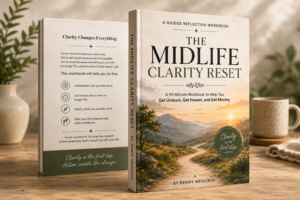
The workbook gives you space to slow down, reflect on your experience, identify patterns, and begin exploring your next chapter in a more structured way.
You don’t need to make a dramatic decision today.
You need a process that helps you create clarity through reflection and action.
Start with the Clarity Reset Workbook and begin collecting evidence about what fits you, what matters to you, and where you may want to go next.
If you’re feeling overwhelmed and need an easier starting point, download my free 15-Minute Reset.
And if you’d prefer to work through your situation with personal guidance, you can book a Midlife Clarity Session with me.
We’ll look at where you are, what’s keeping you stuck, and the next practical action that makes sense for your situation.
Your next chapter doesn’t begin when you finally feel confident.
It begins when you take one thoughtful step and discover that you’re capable of taking another.
Talk soon,
Denny
P.S. Please leave a comment and let me know how this post has helped you, any feedback or experience you feel comfortable sharing. I look forward to reading your thoughts, experiences, and help as much as I can!!
————————–
(Any guides, Workbooks, quizzes and one-to-one clarity sessions are my own and not affiliate based. Please note, I do sometimes share other affiliate links of trusted products and when purchased through a hyperlink on my website may potentially result in a small commission for me. These commissions are not an additional cost to you. I only share products and services I use and trust.)