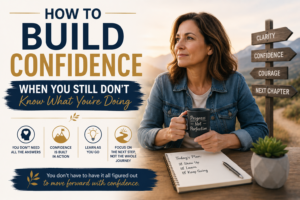
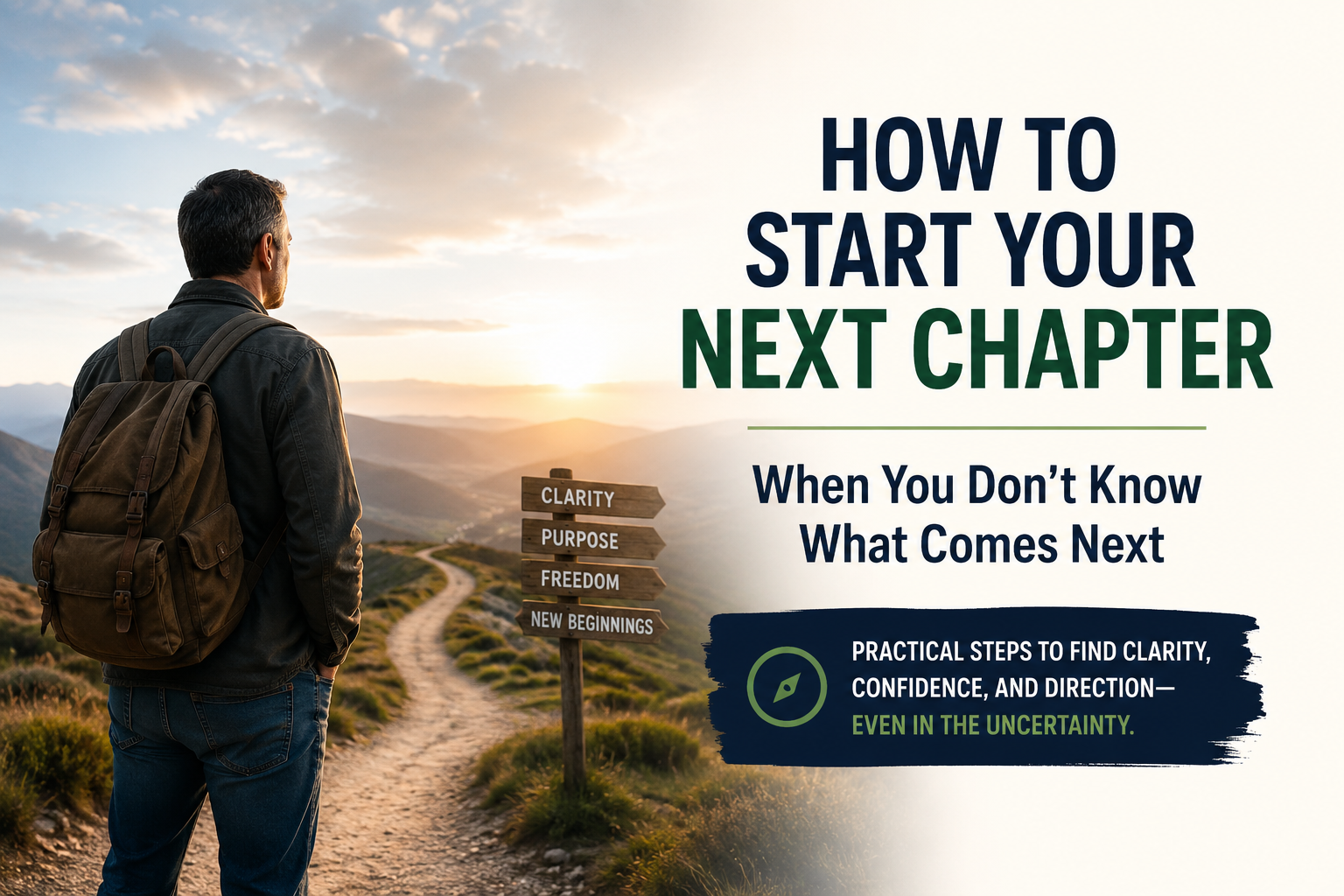
How to Start Your Next Chapter… When You Don’t Know What Comes Next
There comes a point in many people’s lives when they realize something needs to change.
Not necessarily because life is falling apart.
Not because they’ve failed.
Not because they’ve made terrible decisions.
But because the life they’ve been living no longer feels aligned with who they are becoming.
For some people, this realization arrives after losing a job.
For others, it comes after children leave home, health challenges emerge, a relationship changes, or a milestone birthday causes them to reflect on where they are and where they’re headed.
Whatever the reason, the result is often the same.
A growing awareness that the current chapter is ending.
And a deep uncertainty about what comes next.
If that’s where you find yourself today, you’re not alone.
Many people in midlife experience a period of transition where they know they can’t continue exactly as they have been, but they also don’t know what direction to take next.
The challenge is that uncertainty can feel uncomfortable.
So uncomfortable, in fact, that many people remain stuck for years waiting for clarity to arrive.
They tell themselves they’ll take action once they know exactly what they want.
Once they have a perfect plan.
Once they feel certain.
Unfortunately, that certainty rarely arrives first.
In most cases, clarity is not something you find before taking action.
It’s something you develop because of action.
And understanding this may be one of the most important lessons in creating your next chapter.
Why We Want Certainty Before We Begin
Human beings naturally seek certainty.
We like knowing where we’re headed.
We like having plans.
We like feeling in control.
The problem is that reinvention rarely comes with guarantees.
When you’re stepping into unfamiliar territory, there are no perfect maps.
No one can tell you exactly what your next chapter should look like.
And that’s often what creates paralysis.
People begin asking questions such as:
- ✔️ What should I do next?
- ✔️ Should I change careers?
- ✔️ Should I start a business?
- ✔️ Should I retire?
- ✔️ Should I move?
- ✔️ Should I go back to school?
- ✔️ What is my purpose?
These are important questions.
But they are also enormous questions.
And when we try to answer them all at once, we become overwhelmed.
Instead of moving forward, we stay where we are.
Not because we lack motivation.
But because we’re trying to solve an entire future before taking a single step.
The truth is that very few people create meaningful change by figuring out the entire journey in advance.
Most people create change by taking one step, learning from it, and then taking another.
The Myth of the Perfect Path
One of the biggest misconceptions about personal growth is the belief that there is one perfect path waiting to be discovered.
Many people spend years searching for the perfect answer.
The perfect career.
The perfect business idea.
The perfect opportunity.
The perfect purpose.
They believe that once they find it, everything will suddenly become clear.
But life rarely works that way.
Think about your own experiences.
Did you know exactly where your career would lead when you started?
Did you know every twist and turn your life would take?
Probably not.
Most of us discover our path while walking it.
We learn through experience.
We adjust when circumstances change.
We grow into new opportunities.
The same principle applies to reinvention.
Your next chapter is unlikely to appear as a fully formed vision overnight.
Instead, it will emerge through exploration, experimentation, and action.
Clarity Comes From Movement
One of the most common mistakes people make during periods of transition is trying to think their way into clarity.
They spend months, or even years, analyzing possibilities.
Researching options.
Watching videos.
Reading articles.
Taking quizzes.
Thinking.
And thinking.
And thinking some more.
While reflection is valuable, it has limits.
At some point, action becomes necessary.
Because action creates information.
When you try something new, you learn something.
When you attend an event, you learn something.
When you volunteer, start a project, take a course, or have a conversation, you learn something.
Each experience gives you feedback.
That feedback helps you understand what feels aligned and what doesn’t.
Imagine driving at night.
Your headlights don’t illuminate the entire journey.
They only reveal a short section of road ahead.
Yet that’s enough to keep moving.
As you drive forward, more of the road becomes visible.
Your next chapter works the same way.
You don’t need to see the entire path.
You only need enough visibility to take the next step.
Stop Trying to Figure Out the Next Ten Years
One reason people feel overwhelmed is because they’re asking questions that are too big.
They want answers about the next decade.
But what if the better question is much smaller?
Instead of asking:
“What should I do for the next ten years?”
Ask:
“What is one meaningful step I can take this month?”
Instead of asking:
“What is my purpose?”
Ask:
“What am I curious about?”
Instead of asking:
“What should my future look like?”
Ask:
“What feels interesting right now?”
Smaller questions are easier to answer.
And smaller answers create momentum.
The goal isn’t to solve your entire future.
The goal is to begin moving toward it.
Follow Curiosity Instead of Pressure
Many people approach reinvention with enormous pressure.
They feel pressure to get it right.
Pressure to make the perfect decision.
Pressure to find the answer quickly.
Pressure to stop feeling uncertain.
But pressure often creates fear.
Curiosity creates possibility.
Curiosity sounds different.
Curiosity asks:
- ✔️ What interests me?
- ✔️ What energizes me?
- ✔️ What would I enjoy learning more about?
- ✔️ What have I always wanted to explore?
- ✔️ What activities make me lose track of time?
Curiosity doesn’t demand immediate answers.
It simply invites exploration.
And exploration is often where breakthroughs occur.
Many people discover new careers, businesses, hobbies, and passions not because they had a master plan but because they followed their curiosity.
They gave themselves permission to explore.
And that exploration eventually revealed a new direction.
Give Yourself Permission to Be a Beginner Again
One challenge many people face in midlife is that they’ve become accustomed to competence.
They’ve spent years developing expertise.
They know what they’re doing.
They’re experienced.
Capable.
Respected.
Then reinvention comes along and asks them to become beginners again.
That can feel uncomfortable.
Many people avoid trying new things because they don’t want to feel inexperienced.
But growth always involves a learning curve.
Every expert was once a beginner.
Every successful business owner once had no customers.
Every writer once had a blank page.
Every speaker once had their first audience.
Your willingness to be a beginner may be one of the greatest strengths you bring into your next chapter.
Because beginners are willing to learn.
And learning creates growth.
Small Steps Create Momentum
One of the biggest myths about change is that it requires dramatic action.
In reality, meaningful transformation often begins with surprisingly small steps.
A conversation.
A book.
A workshop.
A side project.
A volunteer opportunity.
A new hobby.
A networking event.
A daily habit.
These actions may seem insignificant in the moment.
But momentum compounds.
One step leads to another.
One opportunity creates another.
One conversation opens a door.
One experiment reveals a new possibility.
You don’t need a giant leap.
You need a starting point.
What If You Stopped Waiting?
Consider this question for a moment:
What would happen if you stopped waiting for certainty?
What if you stopped waiting to feel completely ready?
What if you stopped waiting for permission?
What if you accepted that uncertainty is part of growth?
Because the reality is that most meaningful changes begin before we feel fully prepared.
The people who create new chapters aren’t necessarily the people with the most confidence.
They’re often the people willing to move forward despite uncertainty.
They take the next step.
Then the next.
Then the next.
And eventually, what once felt unclear begins to make sense.
Your Next Chapter Begins Today
If you’re in a season of transition, remember this:
You do not need all the answers.
You do not need a perfect plan.
You do not need certainty.
You simply need a willingness to begin.
Your next chapter won’t be created overnight.
It will be built one conversation, one decision, one experiment, and one small step at a time.
The future doesn’t require you to have everything figured out.
It simply asks that you move forward.
And often, that first small step becomes the beginning of an entirely new life.
Your Next Step
If you’re unsure where to begin, start with my free 15-Minute Reset.
It’s designed to help you quiet the noise, reconnect with what matters most, and identify a meaningful next step forward.
Because you don’t need to see the entire path.
You only need enough courage to take the next step.
Download your free 15-Minute Reset here.
Talk soon,
Denny
P.S. Please leave a comment and share how this post has helped you, any feedback or experience you feel comfortable sharing. I look forward to reading your thoughts, experiences, and help as much as I can!!
————————–
(Any guides, Workbooks, quizzes and one-to-one clarity sessions are my own and not affiliate based. Please note, I do sometimes share other affiliate links of trusted products and when purchased through a hyperlink on my website may potentially result in a small commission for me. These commissions are not an additional cost to you. I only share products and services I use and trust.)